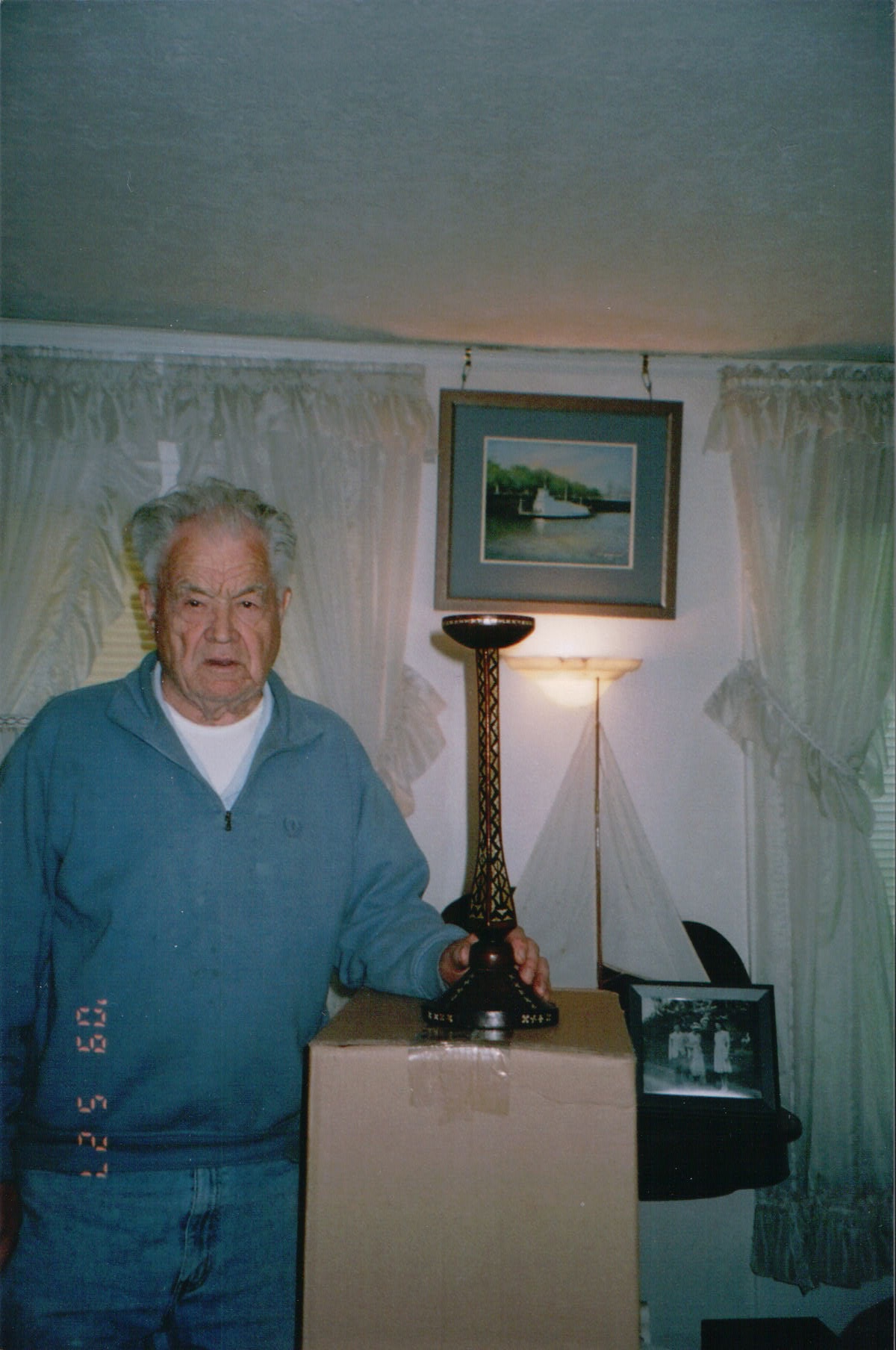

collected from stories and notes Don wrote after the war
I love to tell this story about my dad. The story below, published in the Solomon Times on June 22, 2009, tells about a candlestick that dad had sent home from the war. In his letter homes, there are just a few items he collected that he really wanted to keep. The candlestick was one of them. Then, decades later, he felt the need to return it to the people and the country it belonged to.
To fully appreciate the journey Don must have taken, we need to remember what was happening at the beginning of the story. Don was young man, fighting the enemy and struggling to stay alive. He was driving a landing craft and had multiple near misses after being assigned duty on Tulagi. His boat was nearly hit during an air-raid. He almost died from malaria and dysentery. The order of the day was to take no prisoners. While the Japanese were the enemy, the local people of the islands were sometimes considered incidental. Food shortages and difficult living conditions left little room for empathy with the people of the area.
I remember, as a young child, hearing dad speak about the “Japs” as if they were less-than. He carried the prejudices of his peers and of the times.
I grew up looking at this candlestick somehow knowing it was a prize, hard won, from the bad guys.
Over time, dad left the prejudice behind. He developed a strong sense of empathy for all of the victims of all wars. Somewhere, along the way, it became important to him to return the souvenir candlestick to where it belonged as a sign of respect.
A hand carved wooden candle holder from the Solomon Islands has been returned to Prime Minister Dr Derek on Saturday, 67 years after it was discovered at a location in the Gela group of Islands (Florida Islands) by a US Navyman during World War II.
Eighty-four year old Don Chalmers, who fought here during World War II, returned the carved candlestick holder to Prime Minister Dr Derek Sikua through a fellow American Dr Eileen S. Natuzzi.
Dr Eileen came to Solomon Islands in 2008 as a worker under the Loloma Foundation program.
She went back to the US and wrote a War Veteran Story which was published in one daily magazine there.
Upon reading the story, Mr Don Chalmers immediately contacted her through email seeking advice on how he could return the artifact to Solomon Islands.
Through their email contacts, Mr Chalmers relayed his story to Dr Eileen about how he got the carved candlestick holder.
“In 1942 August I was assigned on the US boat Coxswain for more than four months. While stationed at Gavutu Islands; I made a tour of part of the Florida Islands and came upon a native chapel that has been ransacked by the Japanese”
“I found two beautifully hand carved candlestick holders, one of which made it home with me.”
Mr Chalmers said he had sent a letter to the Honiara City Mayor asking who might be the proper person to contact regarding returning of the object.
At the handover of the candlestick holder last Saturday, Prime Minister Dr Derek Sikua acknowledge Don Chalmers for his time here serving during world war two and having a heartfelt commitment to seek propriety in retuning the candlestick holder.
Prime Minister Sikua also commended Dr Eileen for the correspondent she made with Don Chalmers to enable the candlestick holder returned to Solomon Islands.
He said the candlestick holder will be handed over to the national museum for storage and also for show.
https://www.solomontimes.com/news/us-war-veteran-returns-old-wooden-candle-holder/41
The LaBarge Diary completely skips over one of the most noteworthy experiences of Don’s Naval career. It was so important that Don wrote a 4-page story describing his experience and included a hand drawn diagram to illustrate what took place. We can only image what must have gone through the mind of our newly minted sailor during the hours of uncertainty.
–from LaBarge Diary
February 19, 1942. Departed in company with several other ships all loaded the same as we.
February 21, 1942. Anchored in Halifax, Nova Scotia, harbor. LAT 44050 N. Long. 63-30 W. Here to fuel the destroyers. A very pretty harbor with snowcapped hills surrounding. The whole area is hilly. Did not get off the ship. 1900 underway and out of the harbor
March 3, 1942. Reykjavik, Iceland. Went alongside the inner dock and unloaded the Army troops and cargo and took aboard a load of Marines with their organizational equipment. Most of them were same Marines that we had brought up to Iceland.
By Don Chalmers
Background: While a young seaman of nineteen years on board the USS Heywood, Amphibious Attack Transport, the ship made the third of three trips to Reykjavik, Iceland, shortly after the Pearl Harbor attack on December 7,1941. It was on this trip, just a day out of Iceland, that we encountered a violent North Atlantic storm.
This episode has remained etched in my memory over the years; and, recently, I obtained copies of the ship’s log for the three trips to provide specific information as to the chain of events from official records.
We left Halifax, Nova Scotia on 21 February at 1610 (4:10 PM), experiencing heavy snow with “visibility zero” shortly before midnight. The log shows that at 0720 22 Feb., 1942 “Roche, J. E. CMM (PA) USN died from lobar pneumonia and Seno fibrinous pleurisy.” Typical log entries show “zigzagging according to plan” and a “S/S of 14.5 knots.” While not mentioned in log (for security reasons) we were traveling in a large convoy in perhaps three or four columns.
First log entry suggesting a rough sea situation is this log entry signed by R.A. Jubitz, Jr., Lt. USNR one of our original Portland Naval Reserve Officers. “Sunday, 1 March, 1942-1201 Vessel rolling and pitching moderately, taking seas aft. Inspection of topside made-all gear apparently secure.” At this time, we were steaming essentially due north and were within approximately one days sailing from Reykjavik.
The decision was made to alter course to the N.W. to allow steaming at an angle with seas on our starboard quarter. This would offset running parallel to the troughs which were building.
The extent of this condition is illustrated by the 1:30 AM ship 10g entry for 2 March 1942. “Ship laboring in heavy quartering starboard seas-shipping seas aft.”
At 0800 I (Don) came up to the bridge for the 8 to 12 wheel watch and I remember the seas to be monstrous. Thirty foot plus would probably not be an exaggeration. I clearly remember that as the ship dropped down in a trough you could not see any of the ships in our convoy. In addition, as of 0624 we had gone to a heading of 280° which put us on a course directly parallel to the storm track and the following seas directly astern.
Having just taken over the helm, I was shortly to learn the perils of conning (the act of controlling a ship) a single-screw ship while running in extremely heavy following seas. I had not remembered until reviewing the ships deck log that it was only a few minutes into my watch that we started to broach to, a very critical situation. I do not recall ever having received instruction in what to expect in these conditions nor do I recall any words of caution from the helmsman I had relieved. Having read the log I would like to express my amazement at the content of the entries which covered what was a condition of extreme peril to the ship.
Here is Don’s version.
Shortly after 0800, I found the ship was not responding to normal rudder commands. In attempting to maintain heading, I increased rudder angle until full right rudder was applied. No response.
With the ship swinging toward a full 90° left turn (the dreaded “broaching to” maneuver) flank speed was ordered with no results.
At this point the Heywood was effectively on a direct collision course with the USS New Mexico that was steaming in the column to our port side. Seeing this, Capt. Knowles gave the order to “stop engines.” We lost way and the action of the seas shortly put the ship into violent 30-40° rolls.
The anxiety on the bridge was one of near panic, nobody seeming to know what to do. Concern for landing craft stowed in cradles over the cargo hatches breaking loose, cargo shifting, crew and passenger safety, etc. At this point it was announced that suction had been “lost” as the engine sea-water intake had come out of the water on a starboard roll, resulting in no power. In the meantime, the convoy had continued on course with a destroyer staying back as escort.
The extreme rolling continued.
The engines were finally restarted and at this time Lt. Stuart, our navigator and ex-Merchant Marine officer, suggested setting full left rudder and backing the ship down. This was done and the ship backed into the wind and seas and allowed us to resume the original course. Sometime during this course of events, I had been relieved on the wheel by the watch quartermaster.
We caught up with the convoy as it headed basically west toward Greenland. Shortly after noon, the course was reversed 180° and we arrived at Reykjavik approximately twenty hours later and dropped anchor at 0936 3 March 1942.
Some comments.
I don’t know for what reason the official 8 to 12 deck log provides little clue to what really occurred on March 2nd, 1942. No mention of the extreme sea conditions, no mention of “broaching to”, loss of engine power. Only these entries to suggest something out of the ordinary:
0805 Ship lost steerageway
0810 Backed full to regain heading
0817 Regained heading, ahead standard speed-knots
0920 Received report that at 0815 this date Hotujec, D. R. , S 2/C USN received first degree burns on both ankles. Accident caused by ship lurching as man took pan from oven in gally on duty. No apparent negligence, not incapacitated for duty.
Lt. (JG) USNR
One can only speculate on possible consequences to this ship if conditions had not gone right. I know I had learned an appreciation for following sea conditions and used this experience to good advantage in subsequent years of running single screw landing craft in rough sea conditions.
Below is a plot of ships track for March 1,2 & 3, 1942.

Three guys from Glencullen joined the Portland Naval reserve in 1939: Gordon Balough, Jerry Pomeroy, Don Chalmers.
Who initiated this move and the circumstances are lost in memory, but the point is this: you got a uniform, got paid some, every once in a while, and every Thursday night we went down to the building for a several hour drill. Then, on the way home, walk up and down S. W. Broadway!
In addition, about once a month, in the better weather months, we made a weekend cruise down the Columbia in the Portland Naval Reserve “Eagle Boat”, an ancient patrol-type auxiliary built by Henry Ford during the first W.W. Reportedly, these boats were so poorly designed that in order to offset a serious stability problem, the bilge was filled with cement. Nobody ever suggested where the boats saw fighting duty, but maybe it was on the Great Lakes. Regardless, we thought they were pretty impressive and it was an important Saturday when the 6th Division had its turn to take the Eagle boat down the Columbia River to Astoria and return Sunday.
In retrospect the career, regular Navy crew that were permanently assigned to our Eagle boat on the N. W. waterfront were pretty brave people. I should mention that one of the memories of the weekend cruise as an apprentice seaman was the potato peeling sessions on the fantail of the ship. Also, the really comic mooring of the ship when we came in to tie up to the pilings on NW Front Street. We had our own private spot and our Naval Reserve division officers had to have their practice getting the ship tied up. They needed it, the practice that is.
Thursday night drills were pretty much routine; drill, signal practice, navigation discussion, knot tying practice, etc. aligned to the particular rating, the individual was involved in. The concept was to have in the + two Portland divisions (3rd and 6th) a cross-section of all ratings typically found on a naval ship and a group that could take over a full-time ship in time of emergency.
The major activity came in the summer of 1940 – graduation from Benson High School in June 1940 and the two week summer cruise. The Portland divisions were each going aboard two of the US Navy four-stack WWI destroyers and sail off to the waters off Southern California! The two ships arrived at the Portland seawall. (See the picture from Oregonian.) We would, in effect, take the place of regular crew members who would be taking time off. [Don is top, far left, on board the USS Kennison.]
It has been a long time (over 42 years) but many incidents stand out.
Off we went with our seabags packed per regulation except Don made on tactical error taking along a pair of pajamas. I wore these one night and after the ribbing they ended up at the bottom of the seabag, never to be worn again in naval duty. Upon going over the Columbia bar, I was standing look out watch on the starboard side under the bridge, when someone on the bridge let go his last meal – oh. well!